
Description

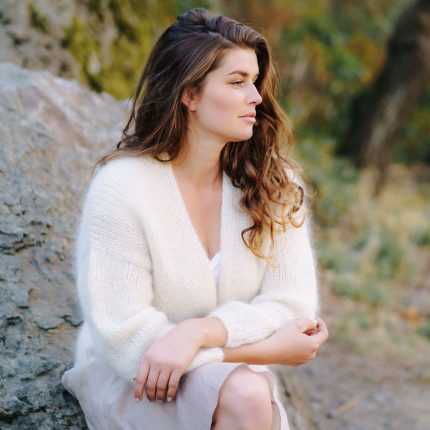
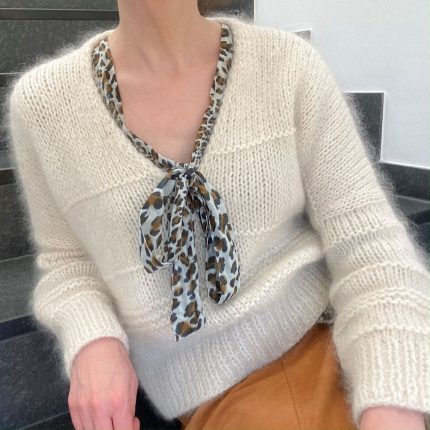
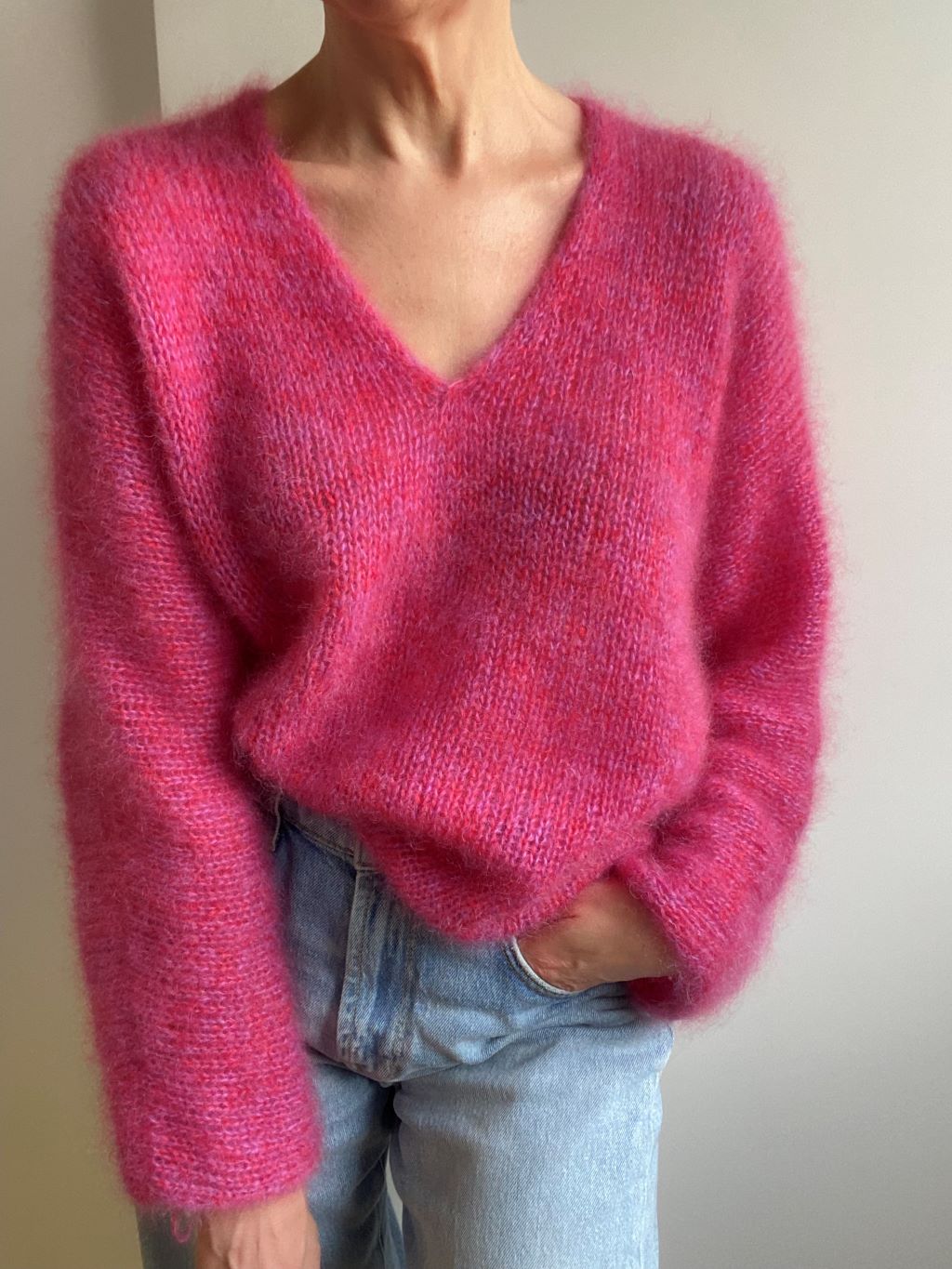
The KIM V-Neck Jumper is a casual sweater with a subtle V-neck and integrated sleeves. The shoulder-and-sleeve area is shaped with short rows, giving the jumper its great fit and distinctive cut.

Description

The KIM V-Neck Jumper is a relaxed V-neck sweater with integrated sleeves, meaning the sleeves are worked directly as part of both the back and the front.

Short rows are worked across the entire width of the shoulders and sleeves at the beginning, which gives the jumper its excellent fit and unique shape.

First, the right and left back front bands are worked and then placed on hold. Next, the back is worked onto the long edge of the band and, after shaping the shoulder/sleeve slopes, it is worked straight down to the armholes.

Then the left and right fronts are worked one after the other, separately. The stitches of the held band are integrated into the respective front, and the short rows are repeated in reverse to mirror the back. Increases for the V-neck are worked on the fronts, and once the V-neck depth is reached, both fronts are joined and then also worked down to the armholes.

The sleeves are closed using Kitchener stitch (grafting). Afterwards, the body is continued in the round to the end, with a few decreases to create a nice curve under the sleeves.

The hem is finished with an I-cord bind-off. Thanks to special edge stitches, the raw edges at the sleeve openings and at the V-neck do not require an I-cord edging.

The detailed pattern is written row by row.

Feel inspired by the beautiful projects on Ravelry or on Instagram.

Top-Down

Details

SIZES / MEASUREMENTS

XS (32/34) S (36/38) M (40/42) L (44/46) XL (48/50) 2XL (52/54), 3XL (56/58)

All measurements in the schematic (Appendix 1) and in the pattern refer to size XS (S) M (L) XL (2XL) 3XL

Size guide for your bust measurement: 76–81 (82–89) 90–97 (98–107) 108–119 (120–131) 131–143 cm

Measurements of the finished knitted garment:

Width after closing the sleeves: 58 (62) 66.5 (70.5) 76.5 (82) 88 cm

Body width after underarm decreases: 48 (52) 56 (60) 65.5 (71.5) 77.5 cm  |  Positive ease approx. 18 (18) 19 (19) 20 (19) 19 cm

Back total length (measured from shoulder): 56 (57) 59 (60) 62 (62.5) 66.5 cm


The model in the photo is 164 cm tall and wears size S with a bust measurement of 85 cm.

For notes and conversions you can use the blank schematic (Appendix 2).

Pattern and gauge

Worked with 4 strands or 3 strands of a mohair-silk yarn (see yarn requirements). Choose needle sizes to match gauge (if you knit loosely, use a smaller needle size; if you knit tightly, use a larger needle size):

Main pattern, stockinette stitch with 6 mm: 14 stitches x 19 rows/rounds = 10 x 10 cm

wool and amount

Model 1: 6.5 mm needles, 4 strands, black, size S: Lamana “Premia” (60% Mohair (Super Kid), 40% Silk): approx. 300m/25g, color no. 01 (black)

Model 2: 6 mm needles, 3 strands, purple-red marled, size S: “Pearl Mohair” (70% Super Kid Mohair, 30% Silk): approx. 210m/25g, 1 strand Poppy + 2 strands Mauve

Base yardage in meters when knitting with 1 strand 600 (675) 750 (825) 900 (975) 1,050 m
For 3-strand knitting multiply base yardage x 3; for 4-strand knitting multiply x 4

Total yarn requirement in grams
Premia by Lamana (25g/300m/4 strands) – 0.33g/m
other mohair-silk yarns
(25g/225m/3 strands) – 0.33g/m
(25g/210m/3 strands) – 0.36g/m

200 (225) 250 (275) 300 (325) 350 g


Yarn requirements for the 3-strand model using mohair-silk yarn 210m/25g in 2 different colors

Color 1
(2 strands)

5

6

7

7

8

9

9

Color 2
(1 strand)

3

3

3

4

4

4

5

Total skeins

8

9

10

11

12

13

14

Last skein of Color 1: use the strand from the center and from the outside edge, or plan for 1 additional skein

x


x

x


x

x

NEEDLES

  • Circular needles 6 mm with an 80–100 cm cable (depending on size)
  • Circular needle 4.5 mm for the I-cord with a cable approx. 60–80 cm long
  • 1 double-pointed needle

SUPPLIES

  • A total of 6 stitch markers for 6 mm needles
  • Extra cable or waste yarn to hold stitches, tape measure, tapestry needle and darning needle, scissors

KNITTING TECHNIQUES

  • Loop cast-on
  • Slip stitches for the edge stitches
  • Short rows with wrap & turn, alternatively with German short rows
  • Increases and decreases
  • Picking up stitches from a knitted piece
  • Kitchener stitch to close the sleeves*
  • I-cord bind-off*


*See also the link collection at https://lotilda.de/kim-jumper-links/

TIP: If some of these knitting techniques are new to you, it is recommended to practice them on a small swatch to avoid having to unravel your finished piece.

For many of the required techniques you can find general photo and/or video recommendations under Special Techniques


Shipping & Delivery

MAECENAS IACULIS

Vestibulum curae torquent diam diam commodo parturient penatibus nunc dui adipiscing convallis bulum parturient suspendisse parturient a.Parturient in parturient scelerisque nibh lectus quam a natoque adipiscing a vestibulum hendrerit et pharetra fames nunc natoque dui.

ADIPISCING CONVALLIS BULUM

  • Vestibulum penatibus nunc dui adipiscing convallis bulum parturient suspendisse.
  • Abitur parturient praesent lectus quam a natoque adipiscing a vestibulum hendre.
  • Diam parturient dictumst parturient scelerisque nibh lectus.

Scelerisque adipiscing bibendum sem vestibulum et in a a a purus lectus faucibus lobortis tincidunt purus lectus nisl class eros.Condimentum a et ullamcorper dictumst mus et tristique elementum nam inceptos hac parturient scelerisque vestibulum amet elit ut volutpat.