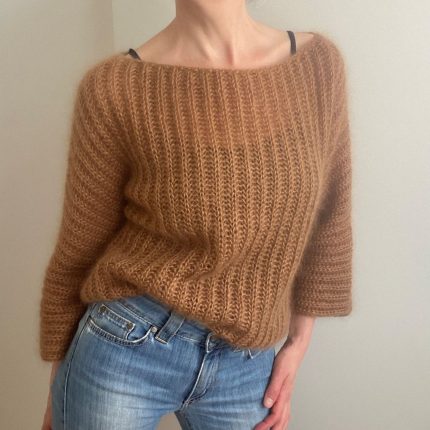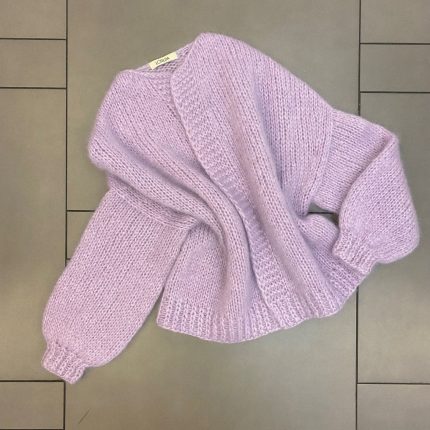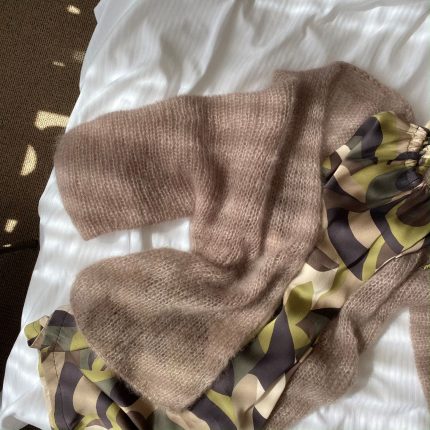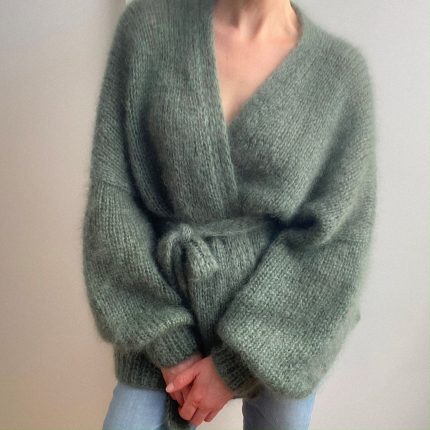

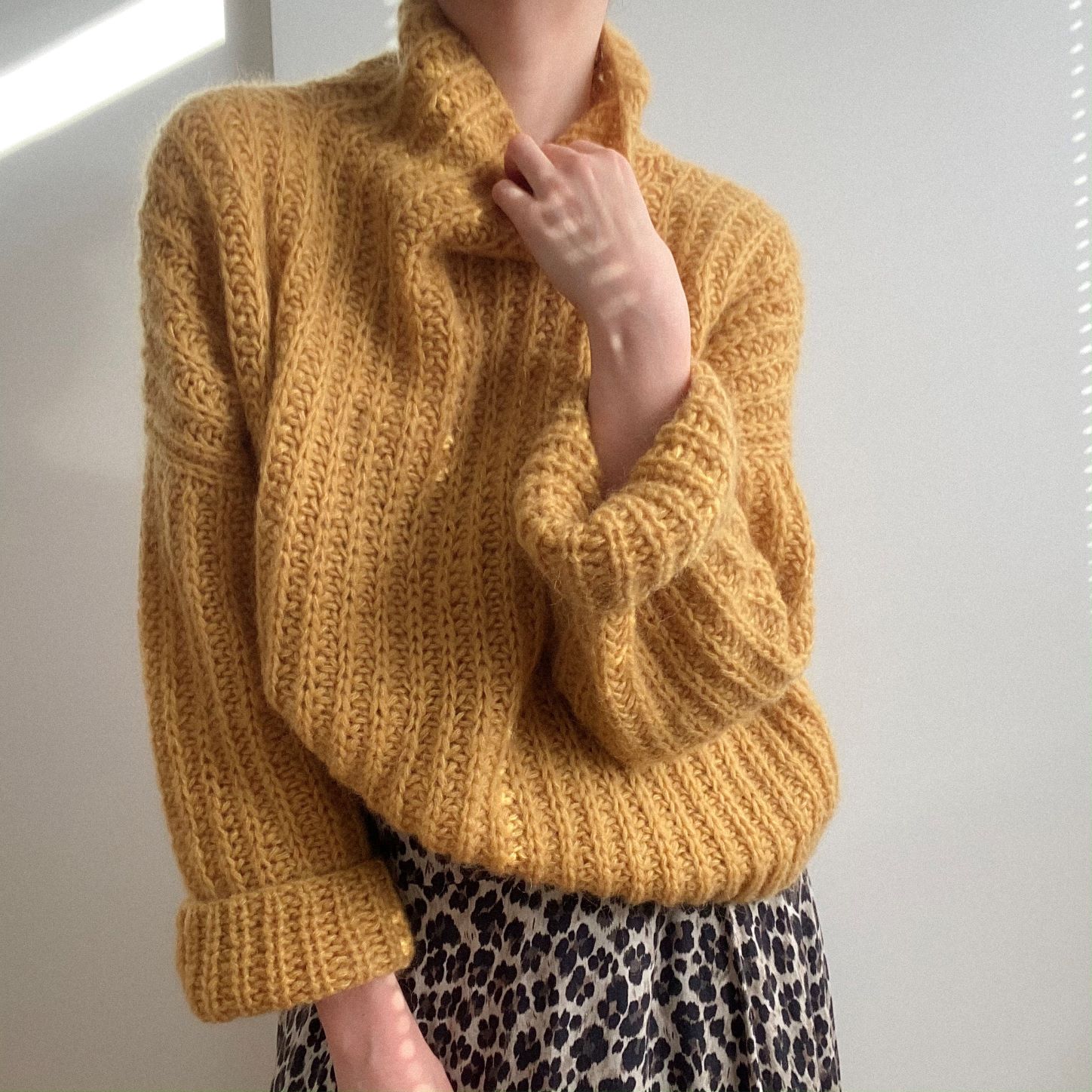
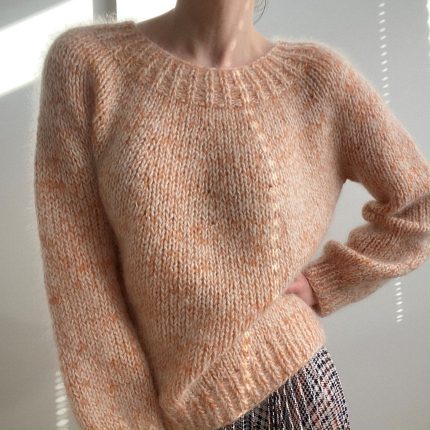
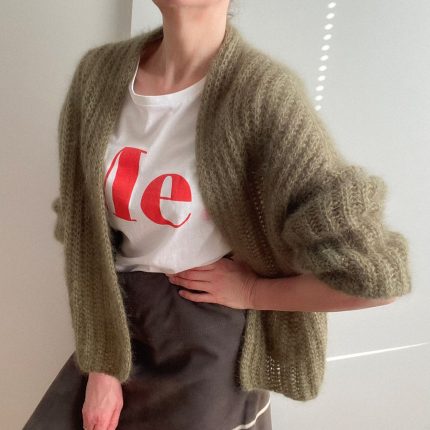
- All instructions refer to size 1 (2) 3 (4) 5 (6).
Standard clothing sizes are intentionally not provided, as the jumper is designed with a very loose fit.
Note: Sizes XL and XXL have not been test knitted!
The JUNA Jumper is worked top-down and shaped only with extended rows (German short rows) and rounds.
The boxy-cut sweater begins in the round with a wide stand-up collar. The collar is then divided, and the back piece is worked first by picking up additional stitches for the shoulders using a loop cast-on.
The JUNA Jumper is worked top-down and shaped exclusively with extended rows and rounds.
The boxy sweater begins in the round with a wide stand-up collar. The collar is then divided, and the back piece is worked first by picking up additional stitches for the shoulders using a loop cast-on. The shoulder slopes and the back neckline are shaped in rows using extended (short) rows and then worked down to the armholes.
The stitches for the front piece are picked up from the cast-on edge of the back piece and the held stitches of the front collar. The front is also shaped at the neckline and shoulders using extended rows.
Under the arms, the front and back pieces are joined again and completed together. Shortly before binding off, the jumper gains additional length at the sides and back through short rows.
The sleeves are picked up from the armholes and worked straight down. Thanks to the top-down construction, the jumper can easily be adjusted to individual measurements.
The short, wide fit pairs perfectly with skirts or jeans. The collar and extra-long sleeves can be folded over to create a different look. Compared to the body, the sleeves are kept slightly slimmer so they can comfortably fit under a parka.
The sequence and stitch counts of the extended rows for the front and back pieces are illustrated separately in a detailed chart.
The pattern also includes a detailed schematic with all measurements, as well as a blank schematic for notes and conversions.
Standard clothing sizes are intentionally not provided, as the jumper is designed with a very loose fit.
Note: Sizes XL and XXL have not been test knitted!
Der MARTA V-Neck Jumper "Summer Edition" wird von oben nach unten in einem Stück mittels Zunahmen an der Schulterpasse und Maschenaufnahmen aus den Strickteilen gestrickt. Der Schnitt ist sehr weit, kurz und kastig mit tiefem V-Ausschnitt und halblangen Ärmeln. Der luftig leichte Schlupfpulli kann mit 2 verschiedenen Saum- und Ärmelabschlüssen gearbeitet werden (I-Cord oder 2 x 2 Bündchen).
Zunächst werden die Maschen für die rechte und linke Blende gestrickt und anschließend Maschen aus der Längsseite beider Blenden aufgenommen. Anschließend werden entlang der Schulterpasse Maschen zugenommen und gleichzeitig verkürzte Reihen für die Formung des hinteren Halsausschnittes gearbeitet.
Nachdem alle Zunahmen entlang der Schulterpasse gearbeitet wurden, werden zunächst das linke und rechte Vorderteil und dann das Rückenteil bis zu den Armausschnitten gestrickt und anschließend wieder gemeinsam zur Runde geschlossen. Der Jumper erhält seitlich und hinten eine Mehrlänge durch verkürzte Reihen.
Für die Ärmel werden Maschen aus dem Armausschnitt aufgenommen und in Runden gestrickt.
Die weite „Summeredition“ Version des MARTA Jumpers mit dem tiefen V-Ausschnitt kann wunderbar über schmale Sommerkleider oder zu Trägertops mit taillierten Röcken oder Jeans kombiniert werden.
Die Anleitung enthält eine ausführliche Modellskizze mit allen Maßangaben, eine blanko Skizze für Notizen oder Umrechnungen, sowie eine technische Zeichnung für die verkürzten Reihen am hinteren Halsausschnitt.
Zugehöriger Brustumfang: 74-82 (82-90) 90-98 (98-107) 107-119 (119-131) cmAlle Angaben in der Anleitung bedeuten Größe XS (S) M (L) XL (XXL)
Das Model auf dem Foto trägt Größe S bei einer Größe von 164 cm und einem Brustumfang von 85 cm.
Brustumfang 120 (126) 135,5 (141,5) 154 (166) cm Mehrweite Brustumfang 40 (38) 40 (38) 39 (40) cm Ärmelumfang 44 (46) 48 (50) 55 (57) cm Breite Jumper 59 (62) 67 (70) 76 (81,5) cm Höhe V-Ausschnitt 29,5 (30,5) 31,5 (34) 36 (38,5) cm Höhe Armausschnitt 22 (23) 24 (25) 27,5 (28,5) cm Höhe Gesamt (ab Beginn Schulterpasse) 56 (58) 60 (62) 65 (67) cmDetaillierte Maßangaben findest Du in der Skizze im Anhang 1.
Für Notizen und Umrechnungen kannst Du die blanko Skizze im Anhang 2 nutzen.
Angegeben ist der Gesamtverbrauch!
Beim zweifarbigen Stricken eine gerade Knäuelanzahl wählen, ggf. aufrunden und beim Verlängern evtl. mehr Garn einplanen.
ALTERNATIVGARNVORSCHLÄGE(1) Alle Mohair-Seidengarne mit einer ähnlichen Lauflänge (ca. 200-210 m/25 g)
(2) Brigitte No. 3 von Lana Grossa (40 % Mohair, 37 % Schurwolle, 23 % Polyamid, ca. 100 m/25 g)
1fädig verstrickt (0,25 g/m)
(3) Manada von Pascuali (45% Superkid-Mohair, 25% Maulbeerseide, 15% Schurwolle (Bio Merino), 15% Yakwolle, ca. 200 m/25 g), 2fädig verstrickt (0,25 g/m)
Garne ohne Mohair:
(4) Midnatssol von Camarose (54 % Alpaka, 36 % Tencel, 10 % Schurwolle, 200m/25g)
2fädig verstrickt (0,25 g/m)
(5) Seta Suri von Lana Grossa (69% Alpaka Suri, 31% Seide, ca. 212 m/25 g)
2fädig verstrickt (0,24 g/m)
Alle hilfreichen Links zum MARTA V-Neck Jumper findest Du auf www.lotilda.de/marta-v-neck-jumper-links/
TIPP: Wenn Dir einige dieser Stricktechniken neu sind, dann empfehle ich diese an einem kleinen Strickstück zu üben, das erspart Dir lästiges ribbeln am Modell.
Für viele der benötigten Techniken findest Du Foto- und oder Video-Empfehlungen unter Spezielle Techniken
ChatGPT: Here is the full English translation: lotilda-knitting-pattern-marta-v-neck-jumper-q3 MARTA V-Neck Jumper "Summer Edition" LOTILDA – Knitting Pattern MARTA V-Neck Jumper "Summer Edition" Knitting Pattern // MARTA V-Neck Jumper "Summer Edition" Caption Description LOTILDA Knitting Pattern: MARTA Jumper – Boxy Oversized Sweater – Knit Your Own Sweater lotilda-knitting-pattern-marta-v-neck-jumper-q2 lotilda-knitting-pattern-marta-v-neck-jumper-q4 lotilda-knitting-pattern-marta-v-neck-jumper-q5 lotilda-knitting-pattern-marta-v-neck-jumper-q6 lotilda-knitting-pattern-marta-v-neck-jumper-q7 lotilda-knitting-pattern-marta-v-neck-jumper-q8 lotilda-knitting-pattern-marta-v-neck-jumper-q9 lotilda-knitting-pattern-marta-v-neck-jumper-q10Strickanleitung ELLA Jumper: Fledermaus Pullover mit V-Ausschnitt und schmalen Ärmeln zum selber stricken (Top-Down).
Der ELLA Jumper ist ein trapezförmig geschnittener Oversize Pullover, der ähnlich wie ein Fledermaus Pullover fällt. Der Jumper wird von oben (Top-Down) durch Maschenaufnahme aus den Strickteilen gestrickt wird. Man beginnt zunächst mit der ersten Blende und dem Vorderteil und formt die überschnittenen Schultern mit verkürzten Reihen. Für den tiefen V-Ausschnitt werden Zunahmen, für die Armschräge Abnahmen gearbeitet und zunächst bis zum Armausschnitt gestrickt.
Das zweite Vorderteil und auch das Rückenteil werden direkt durch Maschenaufnahme angestrickt und ebenfalls bis zum Armausschnitt gearbeitet. Anschließend werden alle drei Teile auf einer Nadel zur Runde geschlossen und gemeinsam beendet. Dabei werden weitere Abnahmen für die Seitenschräge am Unterteil gearbeitet.
Die Ärmel werden ebenfalls durch Maschenaufnahme aus den Armlöchern direkt angestrickt. Durch die Top-Down-Technik kann das Modell sehr leicht an die persönlichen Maße angepasst werden. Die Anleitung enthält eine detaillierte Modellskizze mit allen benötigten Maßangaben.
Als Designelement hat der Jumper hübsche krause Reihen und schöne breite Hebemaschen-Bündchen am Saum und Ärmelsaum.
Maße des fertigen Strickstückes:
Dein Brustumfang: 74-82 (82-90) 90-98 (98-107) 107-119 (119-131) cm
Jumper Brustumfang: 120 (128) 136 (144) 154 (166) cm = die Mehrweite sollte ca. 41-42 cm betragen
Gesamthöhe inkl. Blende und Saum: 54 (55) 56 (57) 59 (61) cm
Der Pulli fällt sehr weit aus, im Zweifel lieber eine Größe kleiner wählen.
Detaillierte Maßangaben findest Du in der Skizze im Anhang 1.
Für Notizen und Umrechnungen kannst Du die blanko Skizze im Anhang 2 nutzen.
3fädig mit jeweils einem Faden jedes Garns, die Nadelstärken passend wählen:
11 Maschen x 16 Runden = 10 x 10 cm {Grundmuster glatt re)Hinweis: Schritt 1 – 3 wird in Hin- und Rückreihen gearbeitet, ab Schritt 4 in Runden. Da die rechten Maschen oftmals fester gestrickt werden als die linken wird für die Rückreihen eine kleinere Nadelstärke als die Hauptnadelstärke benutzt, um ein gleichmäßiges Maschenbild in Reihen und Runden zu erhalten.
in Reihen mit Nadel 9 mm für Rückreihen (li) und 10 mm für Hinreihen (re) in Runden mit Nadel 10 mm in Runden (nur re) Garn 1: Lang Yarns „Lusso“ (36% Wolle (Merino extrafine), 27% Seide, 19% Kamel (Baby), 18% Mohair (Superkid)): ca.180m/25g, UVP 9,95 € Garn 2: Lang Yarns „Mohair Luxe“ (77% Mohair, 23% Seide): ca. 175m/25g, UVP 9,95 € Garn 3: Lang Yarns „Nova“ (48 % Wolle, 32 % Kamel, 20 % Polyamid): ca. 180m/25g, UVP 9,95 € Gewicht der Wolle beim 3fädigen Stricken auf 1 m umgerechnet beträgt: 0,42 g/m Der rosa melierte Ella Jumper ist in der Größe XS mit den Farben Nova in rosa (109), Mohair Luxe in rosa (109) und Lusso in offwhite (094) gestrickt.Der rosa melierte Ella Jumper ist in der Größe XS mit den Farben Nova in rosa (109), Mohair Luxe in rosa (109) und Lusso in offwhite (094) gestrickt.
XS - jeweils 75-100 g der 3 Garne (1.605-2.140 m) S - jeweils 100 g der 3 Garne (2.140 m) M - jeweils 100 g der 3 Garne (2.140 m) L - jeweils 125g der 3 Garne (2.675 m) XL - jeweils 125 g der 3 Garne (2.675 m) XXL - jeweils 125 g der 3 Garne (2.675 m)TIPP: Für die halblangen Ärmel wird bei Größe XS und M 1 Knäuel weniger benötigt.
Die Garnalternativen ergaben in anderen Strickprojekten die gleiche Maschenprobe und dienen lediglich als Anregung. Der angegebene Wollverbrauch beruht ausschließlich auf Berechnungen.
9 mm und 10 mm Rundnadeln, 60 cm lang für das Grundmuster 7 mm Rundnadeln, 60 cm lang für das Bündchenmuster Zusätzlich für die Ärmel 10 mm Rundnadeln, 40 cm lang 7 mm Rundnadeln, 40 cm lang oder jeweils kurze 10 cm lange Nadelspitzen und 20 cm Seil TIPP: kurze Nadelspitzen 10 cm lang von Chiaogoo als Schraubsystem bis Nadelstärke 10 mm möglich / als feste Rundstricknadel von Addi oder KnitPro oder Verwendung der Magic Loop Methode mit langem Seil 80-100 cm, 10 und 7 mm 4 große Maschenmarkierer für die Nadel extra Seile oder Fäden zum Stilllegen von Maschen Verkürzte ReihenTIPP: Wenn Dir einige dieser Stricktechniken neu sind, dann empfehle ich diese an einem kleinen Strickstück zu üben, das erspart Dir lästiges ribbeln am Modell.
Für viele der benötigten Techniken findest Du Foto- und oder Video-Empfehlungen unter Spezielle Techniken
ChatGPT: Here is the full English translation:Knitting Pattern ELLA Jumper: Batwing sweater with V-neck and slim sleeves – knit your own (Top-Down).
The ELLA Jumper is a trapeze-shaped oversized sweater that drapes similarly to a batwing sweater. The jumper is worked from the top down (top-down construction) by picking up stitches from the knitted sections. You begin with the first front band and the first front piece, shaping the dropped shoulders using short rows. Increases are worked for the deep V-neck and decreases for the sleeve slope, knitting down to the armhole.
The second front piece and the back piece are then directly attached by picking up stitches and also worked down to the armhole. Afterwards, all three pieces are joined on one needle in the round and finished together. Additional decreases are worked for the side shaping at the lower body.
The sleeves are also attached directly by picking up stitches from the armholes. Thanks to the top-down construction, the model can easily be adjusted to personal measurements. The pattern includes a detailed schematic with all required measurements.
As a design element, the jumper features beautiful garter stitch rows and wide slip-stitch ribbing at the hem and sleeve cuffs.
SIZES / MEASUREMENTSFinished garment measurements:
Your bust measurement: 74–82 (82–90) 90–98 (98–107) 107–119 (119–131) cm
Jumper bust circumference: 120 (128) 136 (144) 154 (166) cm = positive ease should be approx. 41–42 cm
Total length including band and hem: 54 (55) 56 (57) 59 (61) cm
The sweater has a very loose fit; if in doubt, choose one size smaller.
Detailed measurements can be found in the schematic in Appendix 1.
For notes and conversions, you can use the blank schematic in Appendix 2.
Note: Steps 1–3 are worked flat in rows; from Step 4 onwards in the round. Since knit stitches are often worked tighter than purl stitches, a smaller needle size is used for the wrong-side rows to achieve an even stitch appearance in both rows and rounds.
Worked flat: 9 mm needle for wrong-side rows (purl) 10 mm needle for right-side rows (knit) Worked in the round: 10 mm needle (knit only) YARNS Yarn 1: Lang Yarns “Lusso” (36% Wool (Merino extrafine), 27% Silk, 19% Camel (Baby), 18% Mohair (Superkid)) approx. 180 m / 25 g Yarn 2: Lang Yarns “Mohair Luxe” (77% Mohair, 23% Silk) approx. 175 m / 25 g Yarn 3: Lang Yarns “Nova” (48% Wool, 32% Camel, 20% Polyamide) approx. 180 m / 25 g Yarn weight per meter when knitting with 3 strands held together: 0.42 g/m The pink marled ELLA Jumper shown is knitted in size XS using: Nova in pink (109), Mohair Luxe in pink (109), Lusso in off-white (094). YARN REQUIREMENTS XS – 75–100 g of each of the 3 yarns (1,605–2,140 m) S – 100 g of each of the 3 yarns (2,140 m) M – 100 g of each of the 3 yarns (2,140 m) L – 125 g of each of the 3 yarns (2,675 m) XL – 125 g of each of the 3 yarns (2,675 m) XXL – 125 g of each of the 3 yarns (2,675 m)TIP: For the half-length sleeves, sizes XS and M require one ball less.
The suggested alternative yarns have produced the same gauge in other knitting projects and serve as inspiration only. The stated yarn consumption is based solely on calculations. NEEDLES 9 mm and 10 mm circular needles, 60 cm length for the main pattern 7 mm circular needles, 60 cm length for the ribbing Additionally for the sleeves: 10 mm circular needles, 40 cm length 7 mm circular needles, 40 cm length or short 10 cm needle tips with a 20 cm cable TIP: Short 10 cm interchangeable needle tips by Chiaogoo (available up to 10 mm), fixed circular needles by Addi or KnitPro, or use the Magic Loop method with a long cable (80–100 cm) in 10 mm and 7 mm. 4 large stitch markers Extra cables or waste yarn to hold stitches Short rowsTIP: If some of these knitting techniques are new to you, it is recommended to practice them on a small swatch to avoid having to unravel your finished piece.
You can find photo and/or video tutorials for many of the required techniques under “Special Techniques” at http://lotilda.com/spezielle-techniken/
Du: Der Oversize Cardigan wird im Raglan von oben (RVO) nach unten gestrickt. Das Unterteil wird zur Hüfte hin schmaler und die Vorderteile werden nach unten hin breiter. Die weiten Ärmel werden zum Bündchen hin etwas schmaler und sind in Hin- und Rückreihen gestrickt, die später mit dem Matratzenstich geschlossen werden. Es spricht nichts dagegen die Ärmel in Runden zu stricken, dies ist aber in dieser Anleitung nicht beschrieben (siehe aber Hinweis beim Ärmel). Alle Bündchen und die nachträglich angestrickte Ausschnittblende werden im Hebemaschenbündchen gestrickt. In der Anleitung ist für jede Größe eine separate Hilfstabelle für den Raglanteil vorhanden. Alle Zunahmen sind dort pro Reihen, inklusive der Maschenanzahl aufgeführt. Anhand der Tabelle behältst Du den Überblick und kannst bequem die gestrickten Reihen abhaken und die Zunahmen kontrollieren. #### GRÖSSEN / MaßE ##### Alle Angaben zwischen | bedeuten Größe S | M | L | XL ### einfache Breite unter dem Arm 25 | 27 | 29 | 31 cm Gesamtlänge 60 | 62 | 64 | 66 cm einfache Ärmelbreite 20 | 22 | 24 | 26 cm Ärmellänge inkl. Bündchen 38 cm 10 x 10 cm = 9 Maschen x 12 Reihen Grundmuster: glatt rechts (HR rechts, RR links) mit jeweils 4 Fäden der Silk Mohair und Nadelstärke 10 bzw. entsprechend der Maschenprobe Sandnes Garn „Silk Mohair“ (60 % Mohair, 25 % Seide, 15 % Wolle): 280m/50g, UVP 14,95 €, Farbnummer 4023 „rosameliert“ Rundstricknadeln 8 (MA Blende), 9 und 10 mm, 80 cm lang Ärmel in Runden: Kurze Rundstricknadel 10 mm oder längeres Seil für die Magic Loop Methode 8 Maschenmarkierer extra Seile oder Fäden zum Stillegen der Maschen Wollnadel zum Verschließen der Ärmellängsnaht im Matratzenstich Maschen aufnehmen/abketten Zunahmen links und rechts geneigt Raglan (siehe „Spezielle Techniken“) Matratzenstich (siehe „Spezielle Techniken“) oder beim Stricken in Runden (Ärmel) zusätzlich Magic Loop Methode #### TIPP: Wenn Dir einige dieser Stricktechniken neu sind, dann empfehle ich diese an einem kleinen Strickstück zu üben, das erspart Dir lästiges ribbeln am Modell. Für viele der benötigten Techniken findest Du Foto- und oder Video-Empfehlungen unter Spezielle Techniken ChatGPT: Here is the English translation: The oversized cardigan is worked top-down in raglan construction (RVO – Raglan from the top). The lower body becomes narrower toward the hips, while the front pieces become wider toward the bottom. The wide sleeves taper slightly toward the cuffs and are worked flat in rows, then later closed using the mattress stitch. There is nothing preventing you from knitting the sleeves in the round; however, this is not described in this pattern (see note in the sleeve section). All cuffs and the neckline band, which is picked up and knitted afterwards, are worked in slip-stitch rib. For each size, the pattern includes a separate reference table for the raglan section. All increases are listed there row by row, including stitch counts. Using this table helps you keep track of your progress, tick off completed rows, and monitor your increases easily. SIZES / MEASUREMENTS All values between | indicate sizes S | M | L | XL Half width under the arm: 25 | 27 | 29 | 31 cm Total length: 60 | 62 | 64 | 66 cm Half sleeve width: 20 | 22 | 24 | 26 cm Sleeve length including cuff: 38 cm GAUGE 10 x 10 cm = 9 stitches x 12 rows Main pattern: stockinette stitch (RS knit, WS purl) Worked with 4 strands of Silk Mohair held together using 10 mm needles, or adjust needle size to obtain gauge. YARN Sandnes Garn “Silk Mohair” (60% Mohair, 25% Silk, 15% Wool) 280 m / 50 g Color no. 4023 “rosameliert” (pink marl) NEEDLES & NOTIONS Circular needles 8 mm (for neckline band), 9 mm and 10 mm, 80 cm length For sleeves worked in the round: Short circular needle 10 mm or longer cable for the Magic Loop method 8 stitch markers Extra cables or waste yarn to hold stitches Tapestry needle for closing the sleeve seam using mattress stitch TECHNIQUES USED Picking up stitches / binding off Left- and right-leaning increases Raglan increases (see “Special Techniques”) Mattress stitch (see “Special Techniques”) If knitting sleeves in the round: Magic Loop method TIP: If some of these knitting techniques are new to you, it is recommended to practice them on a small swatch to avoid having to unravel your finished piece. You can find photo and/or video tutorials for many of the required techniques under “Special Techniques” at: http://lotilda.com/spezielle-techniken/ Du:Der Big KIM Cardigan ist die Chunky Oversize Version vom KIM Cardigan und sieht am lässigsten zu Jeans, T-Shirt und Sneakern aus.
In Kombination mit weiten Flatterkleidchen ist der Oversize Look aber ebenfalls perfekt XXL.
#### ####Der Big KIM Cardigan mit weiten Fledermausärmeln wird in einem Stück von oben durch Maschenaufnahme aus den Strickteilen gestrickt. Anders als bei der leichten Sommer Version wird hier anstatt mit dem provisorischen Maschenanschlag für die Schultern und Ärmel mit dem Schlingenanschlag gearbeitet, um den Ärmeln Stabilität zu geben. Der Schulter-Ärmelbereich wird durch verkürzte Reihen geformt und die unteren Ärmelnähte werden mit dem Maschenstich geschlossen, so dass diese unsichtbar bzw. nahtlos bleiben. Der Cardigan hat einen V-Ausschnitt und offene Kanten an den Hals-und Armausschnitten, die mit einem Patentrand abschließen.
Durch Abnahmen an den Seiten des Unterteils erhält der Cardigan eine schöne Rundung unter den Armausschnitten und wird nach unten etwas schmaler.
Die KIM Kollektion umfasst noch zwei weitere Modelle:
KIM Cardigan (luftige, leichte Variante) und das KIM Shirt (Kurzarm Shirt)
####weit und kurz
### Wollnadel ### Vernähnadel ### Schlingenanschlag. linke und rechte Maschen. Verkürzte Reihen mit Wickelmaschen. Zunahmen rechts und links geneigt. Abnahmen rechts geneigt. Patentmaschen (Glattpatent anstatt Bündchen am Saum). ######TIPP: Wenn Dir einige dieser Stricktechniken neu sind, dann empfehle ich diese an einem kleinen Strickstück zu üben, das erspart Dir lästiges ribbeln am Modell.
Für viele der benötigten Techniken findest Du Foto- und oder Video-Empfehlungen unter Spezielle Techniken
ChatGPT: Here is the English translation:The Big KIM Cardigan is the chunky oversized version of the KIM Cardigan and looks most casual when styled with jeans, a T-shirt, and sneakers.
Combined with flowy, wide dresses, the oversized look is also perfectly XXL.
The Big KIM Cardigan with wide batwing sleeves is worked in one piece from the top by picking up stitches from the knitted sections. Unlike the light summer version, this model uses a loop cast-on instead of a provisional cast-on for the shoulders and sleeves to provide more stability to the sleeves.
The shoulder and sleeve area is shaped using short rows, and the lower sleeve seams are closed with the Kitchener stitch (grafting), making them invisible and seamless. The cardigan features a V-neck and open edges at the neckline and armholes, finished with a brioche edge.
Through decreases at the sides of the lower body, the cardigan gains a beautiful rounded shape under the armholes and becomes slightly narrower toward the bottom.
The KIM collection also includes two additional models:
KIM Cardigan (airy, lightweight version) and the KIM Shirt (short-sleeve shirt)
Wide and short fit
Notions Tapestry needle Darning needle Techniques Used Loop cast-on Knit and purl stitches Short rows with wrap and turn Left- and right-leaning increases Right-leaning decreases Brioche stitch (full brioche instead of ribbing at the hem)TIP: If some of these knitting techniques are new to you, it is recommended to practice them on a small swatch to avoid having to unravel your finished piece.
You can find photo and/or video tutorials for many of the required techniques under “Special Techniques” at http://lotilda.com/spezielle-techniken/
Du: Doppelgrößen XS/S | M/L | XL/XXL Länge inklusive Halsblende bis zum Ärmelabschluss 58 | 63 | 68 cm Brustumfang: 140 | 160 | 180 cm Gesamtlänge ab hinterem Halsausschnitt: 64 | 68 | 72 cm mit jeweils 4 Fäden des Garns und Nadelstärke 9 mm bzw. entsprechend der Maschenprobe im Grundmuster Lang Yarns „Mohair Luxe“: 175m/25g, UVP 9,95 €, 77% Mohair, 23% Seide, Farbe Lachs (Farbnr. 128) Gewicht der Wolle beim 4fädigen Stricken auf 1 m umgerechnet beträgt: 0,57 g/m XS/S - 300 g, 12 Knäuel, 2100 m M/L - 350 g, 14 Knäuel, 2450 m XL/XXL - 425 g, 17 Knäuel, 2975 m Rundstricknadeln 6 und 9 mm, XS/S 75 cm | M/L - XL/XXL 100 cm lang ChatGPT: Here is the English translation: Double sizes: XS/S | M/L | XL/XXL Length including neckline band to end of sleeves: 58 | 63 | 68 cm Bust circumference: 140 | 160 | 180 cm Total length from back neckline: 64 | 68 | 72 cm Worked with 4 strands of the yarn held together using 9 mm needles, or adjust needle size to obtain gauge in the main pattern. Lang Yarns “Mohair Luxe” 175 m / 25 g 77% Mohair, 23% Silk Color: Salmon (Color no. 128) Yarn weight per meter when knitting with 4 strands held together: 0.57 g/m XS/S – 300 g, 12 balls, 2,100 m M/L – 350 g, 14 balls, 2,450 m XL/XXL – 425 g, 17 balls, 2,975 m Circular needles 6 mm and 9 mm Length: XS/S – 75 cm M/L – XL/XXL – 100 cm Du:TIPP: Wenn Dir einige dieser Stricktechniken neu sind, dann empfehle ich diese an einem kleinen Strickstück zu üben, das erspart Dir lästiges ribbeln am Modell.
Für viele der benötigten Techniken findest Du Foto- und oder Video-Empfehlungen unter Spezielle Techniken
#### extra Seile oder Fäden zum Stillegen der Maschen #### die engeren Ärmelbündchen können mit 9 mm Rundstricknadel, langem Seil und der Magic Loop Methode gearbeitet werden #### Rundstricknadeln 9 und 10 mm mit 80 cm Seil und kurze Rundstricknadeln 10 mm mit 20 cm (S|M) bzw. 35 cm (L|XL) Seil für die Ärmel #### Maschenanschlag mit 7 mm und 1. Reihe mit 8 mm Rundstricknadel (hier würde ein kurzes Seil reichen, kann aber natürlich auch mit einem langen Seil gestrickt werden) #### Sandnes Garn „Silk Mohair“ (60 % Mohair, 25 % Seide, 15 % Wolle): 280m/50g, UVP 14,95 €, Farbnummer 3511 „puder rosa“ ### Blendenmuster: kraus rechts (Hin- und Rückreihe rechts, dabei die 1. Masche in Hin- und Rückreihen wie zum links stricken abheben mit Faden vor der Arbeit; die letzte Masche immer rechts stricken) ### Blendenmuster: kraus rechts (Hin- und Rückreihe rechts, dabei die 1. Masche in Hin- und Rückreihen wie zum links stricken abheben mit Faden vor der Arbeit; die letzte Masche immer rechts stricken) ### mit jeweils 4 Fäden und Nadel 10 mm bzw. entsprechend der Maschenprobe im Grundmuster #### Grundmuster: glatt rechts (Hinreihe rechts, Rückreihe links) ### Gesamtlänge 57 | 59 | 61 | 63 cm einfache Ärmelbreite 22 | 23 | 24 | 25 cm Ärmellänge 37 cm + Ärmelbündchen 5 cm ### einfache rückwärtige Breite unter dem Arm 25 | 28 | 30 | 32 cm ###Alle Angaben zwischen | bedeuten Größe S | M | L | XL
###weit und kurz
###Der hüftlange Oversize Cardigan mit Blende im kraus rechts Muster wird von oben nach unten gestrickt und erhält seine schräge Passform im Schulterbereich durch Zunahmen entlang der Schulterlinie. Anschließend wird das linke Vorderteil, das Rückenteil und zum Schluß das rechte Vorderteil bis zu den Armausschnitten separat gestrickt und danach wieder gemeinsam auf eine Nadel genommen und beendet.
Die Ärmel werden durch Maschenaufnahme aus den Armausschnitten direkt an das Oberteil gestrickt und in Runden gearbeitet. Durch die langen Ärmel und das enge Ärmelbündchen wird der gewünschte Balloneffekt erzielt. Alle Bündchen werden mit Hebemaschen gestrickt.
####Der MARTA Cardigan ist eine schlichte, moderne Strickjacke im minimalistischen Stil mit liebevollen Details wie die Blende in kraus rechts, Ballonärmel und Bündchen im Hebemaschenmuster. Der Cardigan wird von oben in einem Stück gestrickt und kann perfekt im Frühjahr als Übergangsjacke getragen werden.
|
TIP: If some of these knitting techniques are new to you, it is recommended to practice them on a small swatch to avoid having to unravel your finished piece.
You can find photo and/or video tutorials for many of the required techniques under “Special Techniques” at http://lotilda.com/spezielle-techniken/
Extra cables or waste yarn to hold stitches The narrower sleeve cuffs can be worked using a 9 mm circular needle with a long cable and the Magic Loop method. Circular needles 9 mm and 10 mm with 80 cm cable, and short 10 mm circular needles with 20 cm cable (S | M) or 35 cm cable (L | XL) for the sleeves. Cast-on with 7 mm needle and work the first row with an 8 mm circular needle (a short cable would be sufficient here, but of course you may also use a long cable). Sandnes Garn “Silk Mohair” (60% Mohair, 25% Silk, 15% Wool) 280 m / 50 g Color no. 3511 “powder pink” Front band pattern: garter stitch (knit every row; slip the first stitch of every row purlwise with yarn held in front; always knit the last stitch) Front band pattern: garter stitch (knit every row; slip the first stitch of every row purlwise with yarn held in front; always knit the last stitch) Worked with 4 strands held together using 10 mm needles, or adjust needle size to obtain gauge in the main pattern. Main pattern: stockinette stitch (RS knit, WS purl) Total length: 57 | 59 | 61 | 63 cm Half sleeve width: 22 | 23 | 24 | 25 cm Sleeve length: 37 cm + sleeve cuff 5 cm Half back width under the arm: 25 | 28 | 30 | 32 cmAll values between | indicate sizes S | M | L | XL
Wide and short fit
The hip-length oversized cardigan with garter stitch front band is worked from the top down and gains its slanted shoulder shape through increases along the shoulder line. Then the left front piece, the back piece, and finally the right front piece are worked separately down to the armholes. Afterwards, they are placed back onto one needle and finished together.
The sleeves are attached directly by picking up stitches from the armholes and are worked in the round. The long sleeves combined with the narrow sleeve cuffs create the desired balloon effect. All cuffs are worked in slip-stitch rib.
The MARTA Cardigan is a simple, modern cardigan in a minimalist style with charming details such as the garter stitch front band, balloon sleeves, and cuffs in slip-stitch rib. The cardigan is worked top-down in one piece and is perfect to wear as a transitional jacket in spring.
Du: 6 Maschenmarkierer ChatGPT: 6 Maschenmarkierer → 6 stitch markers Du:Strickanleitung Maya Bluse: Rundpassen-Pullover in Blusenform mit I-Cord-Schleife, tiefem Tröpfchenausschnitt und Ballonärmeln. Der Pullover kann auch mit dem Ausschnitt nach hinten getragen werden.
###Die Maya Bluse wird von oben nach unten mit einer Rundpasse gestrickt. Bei einer Rundpasse werden die Zunahmen für die Ärmel, sowie Rücken- und Vorderteil gleichmäßig über die Passe verteilt jeweils innerhalb einer Reihe gestrickt.
Die Bluse wird zunächst in Hin- und Rückreihen gearbeitet und dann zur Runde geschlossen, wodurch ein tiefer gerader Ausschnitt entsteht. Mit der nachträglich angestrickten I-Cord-Kordel kann man den Ausschnitt entweder lässig knoten oder zur Schleife binden. Der kurze Schnitt passt ideal zu Röcken oder High-Waist-Hosen. Durch die Top-Down-Technik kann die Tiefe des Ausschnittes, die Gesamtlänge und die Ärmellänge leicht angepasst werden.
Der Saum und Ärmelsaum wird ebenfalls mit einem I-Cord-Kordel-Abschluss abgekettet. Durch die engen I-Cord-Abschlüsse fällt der Jumper an den Ärmeln und auf der Hüfte ballonartig.
Die Anleitung enthält im Anhang eine detaillierte Modellskizze mit allen benötigten Maßangaben, sowie eine blanko Modellskizze für Notizen und Anpassungen. Das Model ist 164 cm groß und trägt Größe S.
###weit
### Brustumfang: 74-82 (82-90) 90-98 (98-107) 107-119 (119-131) cm Mittelwert Brustumfang: 78 (86) 94 (103) 113 (125) cm Maße des fertigen Strickstückes: Mehrweite: 11 (10) 12 (12) 11 (12) cm Brustumfang Bluse: 89 (96) 106 (115) 124 (137) cm Länge: 46 (47) 48 (49) 50 (51) cm ####Detaillierte Maßangaben findest Du in der Modellskizze im Anhang 1.
Die blanko Modellskizze im Anhang 2 kannst Du für Notizen und Umrechnungen benutzen.
Beispiele zur Größenauswahl: Dein Brustumfang beträgt 85 cm, das entspricht Größe S. Die fertige Maya Bluse hat bei Größe S einen Brustumfang von 96 cm, so dass deine persönliche Mehrweite dann 96 cm - 85 cm = 11 cm beträgt.
Dein Brustumfang beträgt 98 cm, so liegst Du genau zwischen Größe M und L. Der Brustumfang der fertigen Maya Bluse beträgt bei Größe M 106 cm und bei Größe L 115 cm. Dies entspricht einer Mehrweite bei M von 8 cm und bei L von 17 cm. Du solltest nun entscheiden, ob Du die Bluse lieber weiter oder enger haben möchtest und dementsprechend die Größe auswählen.
Die Garnalternativen ergaben in anderen Strickprojekten die gleiche Maschenprobe und dienen lediglich als Anregung. Der angegebene Wollverbrauch beruht ausschließlich auf Berechnungen.
### Rundstricknadeln 5 mm, 6 mm und 6,5 mm, 60 - 100 cm lang ## Häkelnadel ca. 4 - 6 mm (die Größe der Häkelnadel hat keinen Einfluss auf die Größe der Maschen, sie dient lediglich als Hilfsmittel zum Aufschlingen von Maschen ## 2 Nadelspielnadeln für die I-Cord-Kordel ## Zusätzlich für die Ärmel ## Rundstricknadel 6,5 mm, 40 cm lang ## alternativ Magic Loop mit Rundstricknadel 6,5 mm, 80 - 100 cm lang ## oder Nadelspiel 6,5 mm ## 2 große Maschenmarkierer für die Nadel ## Provisorischer Maschenanschlag mit Häkelnadel ## Rechte und Linke Maschen ## Zunahmen (rechts und links geneigt) ## Ärmel: Magic Loop, Nadelspiel oder kurze Rundstricknadeln (40 cm) ## I-Cord-Kordel stricken und abketten ##TIPP: Wenn Dir einige dieser Stricktechniken neu sind, dann empfehle ich diese an einem kleinen Strickstück zu üben, das erspart Dir lästiges ribbeln am Modell.
Für viele der benötigten Techniken findest Du Foto- und oder Video-Empfehlungen unter Spezielle Techniken
ChatGPT: Here is the complete English translation:Knitting Pattern Maya Blouse: Circular yoke sweater in a blouse shape with I-cord tie, deep keyhole neckline, and balloon sleeves. The sweater can also be worn with the neckline at the back.
The Maya Blouse is worked top-down with a circular yoke. In a circular yoke construction, the increases for the sleeves as well as the back and front pieces are distributed evenly across the yoke and worked within the same round.
The blouse is first worked flat in rows and then joined in the round, creating a deep straight neckline. The I-cord tie, which is attached afterwards, allows you to either knot the neckline casually or tie it into a bow. The cropped cut pairs perfectly with skirts or high-waisted trousers. Thanks to the top-down technique, the neckline depth, total length, and sleeve length can easily be adjusted.
The hem and sleeve hems are also finished with an I-cord bind-off. The tight I-cord finishes create a balloon effect at the sleeves and at the hips.
The pattern includes a detailed schematic with all required measurements in Appendix 1, as well as a blank schematic in Appendix 2 for notes and adjustments. The model is 164 cm tall and is wearing size S.
Loose fit
Bust measurement: 74–82 (82–90) 90–98 (98–107) 107–119 (119–131) cm Average bust measurement: 78 (86) 94 (103) 113 (125) cm Finished garment measurements: Positive ease: 11 (10) 12 (12) 11 (12) cm Blouse bust circumference: 89 (96) 106 (115) 124 (137) cm Length: 46 (47) 48 (49) 50 (51) cmDetailed measurements can be found in the schematic in Appendix 1.
The blank schematic in Appendix 2 can be used for notes and conversions.
The suggested alternative yarns have produced the same gauge in other knitting projects and serve as inspiration only. The stated yarn consumption is based solely on calculations.
Needles & Notions Circular needles 5 mm, 6 mm, and 6.5 mm, 60–100 cm length Crochet hook approx. 4–6 mm (The crochet hook size does not affect stitch size; it is only used to help place stitches.) 2 double-pointed needles for the I-cord tie Additionally for the sleeves: Circular needle 6.5 mm, 40 cm length Alternatively: Magic Loop method with 6.5 mm circular needle, 80–100 cm cable or 6.5 mm double-pointed needles 2 large stitch markers Provisional cast-on with crochet hook Knit and purl stitches Increases (left- and right-leaning) Sleeves: Magic Loop, double-pointed needles, or short circular needles (40 cm) Knitting and binding off the I-cord tieTIP: If some of these knitting techniques are new to you, it is recommended to practice them on a small swatch to avoid having to unravel your finished piece.
You can find photo and/or video tutorials for many of the required techniques under “Special Techniques” at http://lotilda.com/spezielle-techniken/
Du: TIPP: Wenn Dir einige dieser Stricktechniken neu sind, dann empfehle ich diese an einem kleinen Strickstück zu üben, das erspart Dir lästiges ribbeln am Modell. Für viele der benötigten Techniken findest Du Foto- und oder Video-Empfehlungen unter Spezielle Techniken ### I-Cord-Kordelkante abketten ## Variante 2: ## Maschen abketten ## Hebemaschen beim Bündchen ## Patentmaschen mit Umschlag ## linke Maschen ## Variante 1: ## Ärmel/-bündchen: Magic Loop, Nadelspiel oder kurze Rundstricknadeln (40 cm) ## Zunahmen und Abnahmen ## Rechte Maschen ## Provisorischer Maschenanschlag mit Häkelnadel ## extra Seile oder Fäden zum Stillegen von Maschen ## 1 großer Maschenmarkierer für die Nadel ## Rundstricknadel 9 mm Seile: 20, 35, 50 (große Größen zusätzlich 80) cm Nadelspitzen: 10 und 13 cm lang ## Variante 2: ## Grundmuster - Rundstricknadel 9 mm Seile: 50 (große Größen 80) cm Nadelspitzen: 13 cm lang ## Passe - Rundstricknadel 8 mm Seile: 20, 35, 50 (große Größen zusätzlich 80) cm Nadelspitzen: 10 und 13 cm lang ## Variante 1: ## Rundstricknadel 7 mm: 20 cm Seil und kurze 10 cm lange Nadelspitzen = 40 cm ## Häkelnadel ca. 4-7 mm ## Die gestreifte Version wurde statt 3fädig mit 4 Fäden Mohair gestrickt. Alle Details zu dieser Abwandlung der Anleitung hier: https://www.ravelry.com/projects/Lotilda/maya-jumper ### Größe L-XXL 300 g (2.160 m) #### Größe XS-M 225g (1.620 m) ### ca. 175m/25g, UVP 9,95 €, Farbnummer 168 (cognac) Gewicht der Wolle beim 3fädigen Stricken auf 1 m umgerechnet beträgt: 0,43 g/m ### Lang Yarns „Mohair Luxe“ (77% Mohair, 23% Seide) ### Variante 2 (glatt rechts): ### Größe L-XXL 300 g (2.100 m) ### Größe XS-M 225g (1.575 m) ### ca.180m/25g, UVP 9,95 €, Farbnummer 019 (rosa dunkel) Gewicht der Wolle beim 3fädigen Stricken auf 1 m umgerechnet beträgt: 0,42 g/m ### Lang Yarns „Lusso“ (36% Wolle (Merino extrafine), 27% Seide, 19% Kamel (Baby), 18% Mohair (Superkid)) ### Variante 1 (Passe mit Patentmuster): ### 10 x 10 cm = 10 Maschen x 14 Runden ### Grundmuster in glatt rechts, mit Nadel 9 mm und 3 Fäden: ### Länge Gesamt 54 (55) 56 (57) 58 (59) cm ### Brustumfang 89 (97) 105 (113) 124 (136) cm ### Maße des fertigen Strickstückes: ## Der Pullover sollte eine Mehrweite von 11 cm zu deinem Brustumfang haben (positive ease) ### Zugehöriger Brustumfang: 76-80 (84-88) 92-96 (100-104) 110-116 (122-128) cm ### Größe XS (32/34) | S (36/38) | M (40/42) | L (44/46) | XL (48/50) | XXL (52/54) ### GRÖSSEN / MaßE ### halbweit/locker ### Der Maya Jumper wird von oben nach unten mit einer Rundpasse gestrickt. Bei einer Rundpasse werden die Zunahmen für die Ärmel, sowie Rücken- und Vorderteil gleichmäßig über die Passe verteilt jeweils innerhalb einer Reihe gestrickt. Der Jumper kann in zwei Varianten gearbeitet werden. Zum einen mit einer dekorativen Passe aus Patent- und linken Maschen. Bei dieser Variante sind die Zunahmen besonders einfach, da diese durch das Muster auch optisch ersichtlich sind. Saum- und Ärmelsäume erhalten enge Bündchen im Rippenmuster, bei denen die rechten Maschen als Hebemaschen gearbeitet werden. Durch die engen Bündchen fällt der Jumper an den Ärmeln und auf der Hüfte ballonartig. Die zweite Variante wird ganz schlicht in glatt rechts gestrickt und hat dekorative I-Cord-Kordelkanten am Hals, Saum und Ärmel. Anhand einer detaillierten Größentabelle kannst Du deine Maße mit dem des Modells vergleichen und die richtige Größe oder Mixgröße ermitteln. ### Strickanleitung MAYA Jumper: Der einfache Rundpassen Pullover kann entweder in glatt rechts oder mit einem hübschen Muster aus Patent- und linken Maschen gestrickt werden. #### ChatGPT: Here is the complete English translation:TIP: If some of these knitting techniques are new to you, it is recommended to practice them on a small swatch to avoid having to unravel your finished piece.
You can find photo and/or video tutorials for many of the required techniques under “Special Techniques” at http://lotilda.com/spezielle-techniken/
I-cord edge bind-off Variant 2: Bind off stitches Slip stitches in the ribbing Brioche stitches with yarn over Purl stitches Variant 1: Sleeves/cuffs: Magic Loop, double-pointed needles, or short circular needles (40 cm) Increases and decreases Knit stitches Provisional cast-on with crochet hook Extra cables or waste yarn to hold stitches 1 large stitch marker Circular needle 9 mm Cables: 20, 35, 50 (larger sizes additionally 80) cm Needle tips: 10 and 13 cm long Variant 2: Main pattern – circular needle 9 mm Cables: 50 (larger sizes 80) cm Needle tips: 13 cm long Yoke – circular needle 8 mm Cables: 20, 35, 50 (larger sizes additionally 80) cm Needle tips: 10 and 13 cm long Variant 1: Circular needle 7 mm: 20 cm cable and short 10 cm needle tips = 40 cm Crochet hook approx. 4–7 mm The striped version was knitted with 4 strands of mohair instead of 3 strands. All details about this pattern variation can be found here: https://www.ravelry.com/projects/Lotilda/maya-jumper Size L–XXL: 300 g (2,160 m) Size XS–M: 225 g (1,620 m) Approx. 175 m / 25 g, color no. 168 (cognac) Yarn weight per meter when knitting with 3 strands held together: 0.43 g/m Lang Yarns “Mohair Luxe” (77% Mohair, 23% Silk) Variant 2 (stockinette stitch): Size L–XXL: 300 g (2,100 m) Size XS–M: 225 g (1,575 m) Approx. 180 m / 25 g, color no. 019 (dark pink) Yarn weight per meter when knitting with 3 strands held together: 0.42 g/m Lang Yarns “Lusso” (36% Wool (Merino extrafine), 27% Silk, 19% Camel (Baby), 18% Mohair (Superkid)) Variant 1 (yoke with brioche pattern): 10 x 10 cm = 10 stitches x 14 rounds Main pattern in stockinette stitch with 9 mm needles and 3 strands held together Total length: 54 (55) 56 (57) 58 (59) cm Bust circumference: 89 (97) 105 (113) 124 (136) cm Finished garment measurements: The sweater should have approx. 11 cm positive ease compared to your bust measurement. Corresponding bust measurement: 76–80 (84–88) 92–96 (100–104) 110–116 (122–128) cm Size XS (32/34) | S (36/38) | M (40/42) | L (44/46) | XL (48/50) | XXL (52/54) SIZES / MEASUREMENTS Semi-loose fit The Maya Jumper is worked top-down with a circular yoke. In a circular yoke construction, the increases for the sleeves as well as the back and front pieces are distributed evenly across the yoke and worked within the same round. The jumper can be worked in two variations. The first option features a decorative yoke with a pattern of brioche and purl stitches. In this version, the increases are particularly easy to follow, as they are visually integrated into the pattern. The hem and sleeve hems are finished with narrow ribbed cuffs, where the knit stitches are worked as slip stitches. The tight cuffs create a balloon effect at the sleeves and at the hips. The second variation is worked simply in stockinette stitch and features decorative I-cord edges at the neckline, hem, and sleeves. Using the detailed size chart, you can compare your measurements with those of the model to determine the correct size or a mixed size if needed. Knitting Pattern MAYA Jumper: The simple circular yoke sweater can be knitted either in stockinette stitch or with a beautiful pattern of brioche and purl stitches. Du:Der schlichte und kurze Cardigan, mit abgerundetem Halsausschnittbündchen und langen Bündchen am Saum und an den Ärmeln, wird als Raglan von oben nach unten (RVO) gestrickt.
##Der schlichte und kurze Cardigan, mit abgerundetem Halsausschnittbündchen und langen Bündchen am Saum und an den Ärmeln, wird als Raglan von oben nach unten (RVO) gestrickt. Das Unterteil ist hüftlang und hat eine gerade, kurze Form. Die Ärmel werden zum Bündchen hin etwas schmaler und sind in Hin- und Rückreihen gestrickt, die später mit dem Matratzenstich geschlossen werden. Gegen ein Stricken in Runden (siehe Hinweis beim Ärmel) spricht nichts, ist aber in dieser Anleitung nicht beschrieben. Alle Bündchen werden im Hebemaschenbündchen gestrickt.
Die Anleitung beinhaltet für jede Größe eine separate Hilfstabelle für die Raglanzunahmen.
##Alle Angaben zwischen | bedeuten Größe S | M | L | XL
## einfache Breite unter dem Arm 22 | 24 | 26 | 28 cm Gesamtlänge 51 | 53 | 55 | 57 cm einfache Ärmelbreite 15 | 17 | 18 | 20 cm Ärmellänge inkl. Bündchen 48 cm mit jeweils 4 Fäden und Nadelstärke 10 bzw. entsprechend der Maschenprobe Lang Yarns „Mohair Luxe“ (77 % Mohair, 23 % Seide): 175m/25g, UVP 9,95 €, Farbnummer 248 „altrosa“ Rundstricknadeln 9 und 10 mm, 75 cm lang Maschen aufnehmen Verkürzte Reihen (hier mit Wickelmasche) Matratzenstich ###TIPP: Wenn Dir einige dieser Stricktechniken neu sind, dann empfehle ich diese an einem kleinen Strickstück zu üben, das erspart Dir lästiges ribbeln am Modell.
Für viele der benötigten Techniken findest Du Foto- und oder Video-Empfehlungen unter Spezielle Techniken
ChatGPT: Here is the complete English translation:The simple and cropped cardigan, featuring a rounded neckline band and long ribbed cuffs at the hem and sleeves, is worked as a raglan from the top down (RVO).
The simple and cropped cardigan, featuring a rounded neckline band and long ribbed cuffs at the hem and sleeves, is worked as a raglan from the top down (RVO). The body is hip-length with a straight, short shape. The sleeves taper slightly toward the cuffs and are worked flat in rows, then later closed using the mattress stitch. There is nothing preventing you from knitting the sleeves in the round (see note in the sleeve section), but this is not described in this pattern. All cuffs are worked in slip-stitch rib.
The pattern includes a separate reference table for the raglan increases for each size.
All values between | indicate sizes S | M | L | XL
Half width under the arm: 22 | 24 | 26 | 28 cm Total length: 51 | 53 | 55 | 57 cm Half sleeve width: 15 | 17 | 18 | 20 cm Sleeve length including cuff: 48 cm Worked with 4 strands held together using 10 mm needles, or adjust needle size to obtain gauge. Lang Yarns “Mohair Luxe” (77% Mohair, 23% Silk) 175 m / 25 g Color no. 248 “dusty rose” Circular needles 9 mm and 10 mm, 75 cm length Picking up stitches Short rows (worked here with wrap and turn) Mattress stitchTIP: If some of these knitting techniques are new to you, it is recommended to practice them on a small swatch to avoid having to unravel your finished piece.
You can find photo and/or video tutorials for many of the required techniques under “Special Techniques” at http://lotilda.com/spezielle-techniken/
Du:Anleitung im “Baukasten-Prinzip” für eine Oversize Strickjacke mit 2 verschiedenen Halsausschnittvarianten, die von oben (Top Down), nicht als Raglan, sondern durch Maschenaufnahme aus den Strickteilen – gestrickt wird.
####Anleitung im “Baukasten-Prinzip” für eine Oversize Strickjacke mit 2 verschiedenen Halsausschnittvarianten, die von oben (Top Down), nicht als Raglan, sondern durch Maschenaufnahme aus den Strickteilen – gestrickt wird. Man beginnt zunächst mit dem Rückenteil und nimmt anschließend die Maschen für das rechte Vorderteil auf. Das Gleiche macht man mit dem linken Vorderteil und beendet das Unterteil ab Ende der Armausschnitte gemeinsam.
Variante 1 in rosa mit “einfachem” Halsausschnitt
Variante 2 in natur mit tiefergezogenem Halsausschnitt und im Rücken liegender “Naht”
Geformt wird die Jacke durch verkürzte Reihen im Schulterbereich und durch Zunahmen an den Armausschnitten. Beim Unterteil werden dann wiederum Maschen abgenommen, so daß die Jacke zur Hüfte schmaler wird.
Für die Ärmel werden Maschen aus den Armausschnitten von Vorder- und Rückenteil aufgenommen, sie werden in Hin- und Rückreihen gestrickt und ebenfalls durch verkürzte Reihen und Abnahmen geformt.
Beide Bündchen am Saum und Ärmelsaum werden mit Hebemaschen-Bündchen gestrickt. Schwierigkeitsgrad mittel.
### Weite unter dem Arm: 60 | 64 | 68 | 72 cm ## Rückwertige Länge: 59 | 61 | 63 | 65 cm ## 11 Maschen x 15 Reihen = 10 x 10 cm ## jeweils mit einem Faden Trend & Nova und Nadel Nr. 10 mm bzw. entsprechend der Maschenprobe ## Lang Yarns „Mohair Trend“: 75m/25g, UVP 9,95 €, 70% Mohair, 30% Seide, Variante 1: Farbnummer 09 rosa, Variante 2: Farbnummer 94 natur ## Lang Yarns „Nova“: 180m/25g, UVP 6,95 €, 48% Wolle (Merino), 32% Kamel (Baby), 20% Polyamid, in Variante 1: Farbnummer 009 rosa, Variante 2: Farbnummer 22 natur ##TIPP: Wenn Dir einige dieser Stricktechniken neu sind, dann empfehle ich diese an einem kleinen Strickstück zu üben, das erspart Dir lästiges ribbeln am Modell.
Für viele der benötigten Techniken findest Du Foto- und oder Video-Empfehlungen unter Spezielle Techniken
ChatGPT: Here is the complete English translation:Pattern in a “modular system” for an oversized cardigan with 2 different neckline variations, worked from the top down (Top Down), not as a raglan, but by picking up stitches from the knitted sections.
This pattern follows a “modular system” for an oversized cardigan with 2 different neckline variations, worked from the top down (Top Down), not as a raglan, but by picking up stitches from the knitted sections. You begin with the back piece and then pick up stitches for the right front piece. The same is done for the left front piece, and the lower body is finished together after the armholes.
Variation 1 in pink with a “simple” neckline Variation 2 in natural with a deeper neckline and a “seam” positioned at the back
The cardigan is shaped using short rows in the shoulder area and increases at the armholes. In the lower body section, stitches are decreased again so that the cardigan becomes narrower toward the hips.
For the sleeves, stitches are picked up from the armholes of the front and back pieces. The sleeves are worked flat in rows and are shaped with short rows and decreases.
Both the hem and sleeve cuffs are worked in slip-stitch rib. Difficulty level: intermediate.
Width under the arm: 60 | 64 | 68 | 72 cm Back length: 59 | 61 | 63 | 65 cm Gauge: 11 stitches x 15 rows = 10 x 10 cm Worked with one strand each of Trend & Nova using 10 mm needles, or adjust needle size to obtain gauge. Lang Yarns “Mohair Trend” 75 m / 25 g 70% Mohair, 30% Silk Variation 1: color no. 09 pink Variation 2: color no. 94 natural Lang Yarns “Nova” 180 m / 25 g 48% Wool (Merino), 32% Camel (Baby), 20% Polyamide Variation 1: color no. 009 pink Variation 2: color no. 22 naturalTIP: If some of these knitting techniques are new to you, it is recommended to practice them on a small swatch to avoid having to unravel your finished piece.
You can find photo and/or video tutorials for many of the required techniques under “Special Techniques” at http://lotilda.com/spezielle-techniken/
Du:Die Mohair Strickjacke wird in einem Stück als Raglan von oben (RVO) gestrickt. Der kurze Cardigan hat eine breite Blende, die offen nach außen fällt.
###Die Mohair Strickjacke wird in einem Stück als Raglan von oben (RVO) gestrickt. Der kurze Cardigan hat eine breite Blende, die offen nach außen fällt. Im Rückenteil werden zum Ende verkürzte Reihen gearbeitet, damit die Strickjacke eine gleichmäßige Länge erhält und die Vorderteile durch die breite Blende nicht zu weit über das Rückenteil hinaus nach unten fallen.
Außerdem ist das Unterteil durch ein paar Zunahmen an den Seiten leicht ausgestellt und fällt trapezförmig. Wer das nicht mag, kann die Zunahmen einfach weg lassen.
Die Ärmel sind in Hin- und Rückreihen gestrickt, werden durch ein paar Abnahmen nach unten hin schmaler und müssen zum Schluß mit dem Matratzenstich geschlossen werden. Gegen ein Stricken in Runden spricht nichts, ist aber in dieser Anleitung nicht beschrieben.
##Alle Angaben zwischen | bedeuten Größe S | M | L | XL
## einfache Weite unter dem Arm gemessen: 26 | 28 | 30 | 32 cm ## Rückwertige Länge: 48 | 50 | 52 | 54 cm Breite Blende: 8 cm Grundmuster: kraus rechts (Hin- und Rückreihe rechts) mit jeweils 3 Fäden der Silk Mohair und Nadel 9 mm bzw. entsprechend der Maschenprobe Sandnes Garn „Silk Mohair“ (60 % Mohair, 25 % Seide, 15 % Wolle): 280m/50g, UVP 14,95 €, Farbnummer 1012 „natur“ Rundstricknadeln 8 und 9 mm, 80 cm lang Rechte Maschen Zu- und Abnahmen links und rechts geneigt ##TIPP: Wenn Dir einige dieser Stricktechniken neu sind, dann empfehle ich diese an einem kleinen Strickstück zu üben, das erspart Dir lästiges ribbeln am Modell.
Für viele der benötigten Techniken findest Du Foto- und oder Video-Empfehlungen unter Spezielle Techniken
ChatGPT: Here is the complete English translation:The mohair cardigan is worked in one piece as a raglan from the top down (RVO). The short cardigan features a wide front band that falls open outward.
The mohair cardigan is worked in one piece as a raglan from the top down (RVO). The short cardigan features a wide front band that falls open outward. Short rows are worked at the end of the back piece to ensure an even overall length and to prevent the front pieces, due to the wide band, from extending too far below the back.
Additionally, the lower body is slightly flared through a few increases at the sides, creating a trapeze shape. If you prefer a straight shape, you can simply omit these increases.
The sleeves are worked flat in rows, taper slightly toward the bottom through a few decreases, and must be closed at the end using the mattress stitch. There is nothing preventing you from knitting the sleeves in the round, but this is not described in this pattern.
All values between | indicate sizes S | M | L | XL
Half width under the arm (measured flat): 26 | 28 | 30 | 32 cm Back length: 48 | 50 | 52 | 54 cm Front band width: 8 cm Main pattern: garter stitch (knit every row) Worked with 3 strands of Silk Mohair held together using 9 mm needles, or adjust needle size to obtain gauge. Sandnes Garn “Silk Mohair” (60% Mohair, 25% Silk, 15% Wool) 280 m / 50 g Color no. 1012 “natural” Circular needles 8 mm and 9 mm, 80 cm length Knit stitches Left- and right-leaning increases and decreasesTIP: If some of these knitting techniques are new to you, it is recommended to practice them on a small swatch to avoid having to unravel your finished piece.
You can find photo and/or video tutorials for many of the required techniques under “Special Techniques” at http://lotilda.com/spezielle-techniken/
Du:Strickanleitung MIA Jumper: Der Rundpassen Pullover hat einen ovalen Rundhalsausschnitt und leichte Keulenärmel, die zum Handgelenk minimal weiter werden.
##Der Mia Jumper wird von oben nach unten mit einer Rundpasse gestrickt.
Der kurze Jumper wird in Runden mit einem weiten, ovalen Halsbündchen im Hebemaschenbündchen begonnen, in dem bereits die erste Zunahmerrunde gearbeitet wird, anschließend werden weitere 5 Zunahmerunden gleichmäßig über die Passe verteilt gestrickt.
Nachdem Ärmel und Rumpf abgeteilt wurden, wird weiter in Runden gearbeitet, wobei der Jumper durch ein paar Abnahmen unter den Armen kleine Rundungen erhält. Der Rumpf wird kurz vor Ende des Saumbündchens mit verlängerten Reihen geformt und erhält hierdurch hinten eine minimale Mehrlänge. Der kurze Schnitt passt ideal zu taillierten Röcken oder High-Waist-Hosen.
Die 7/8 Ärmeln halten die Hände frei und machen den Jumper somit auch zu einem alltagstauglichen Pullover. Die Ärmel erhalten einige Zunahmen, sodass diese dezent keulenhaft wirken.
Die Anleitung enthält eine detaillierte Modellskizze mit allen Maßangaben, sowie eine Blankoskizze für Notizen und Umrechnungen.
##Das Model auf dem Foto ist 164 cm groß und trägt Größe S bei einem Brustumfang von 85 cm.
Alle Angaben in der Anleitung bedeuten Größe XS (S) M (L) XL (XXL)
##Hinweis: Größen XL und XXL wurden nicht testgestrickt!
## Dein Brustumfang: 74-82 (82-90) 90-98 (98-107) 107-119 (119-131) cm Der Jumper hat eine Mehrweite von ca. 18 cm Brustumfang Pullover: 98 (104) 113 (123) 132 (143) cm Gesamtlänge (ohne Hals- und Saumbündchen): 36 (38) 39 (41) 43 (45,5) cm Ärmellänge (ohne Saumbündchen): 32 cm (7/8 Länge) Bündchenlänge je nach Nadelstärke (6 oder 7 mm): 5 oder 6 cm (Die Bündchen des orange melierten Jumpers wurden mit 6 mm Nadel gestrickt) 10 x 10 cm = 11 Maschen x 17 Runden 3fädig, die Nadelstärken passend wählen ##Hinweis: Bitte beachte, dass sich die Maschenprobe beim Stricken in Runden von der Maschenprobe in Reihen unterscheiden kann. Sollten deine linken Maschen lockerer ausfallen, so kannst Du das Stricken in Runden simulieren, indem Du eine Nadelstärke kleiner für die Rückreihen wählst.
## Garn 1: Lang Yarns „Nova“, Farbe orange 059 (48 % Wolle, 32 % Kamel, 20 % Polyamid): ca. 180m/25g, UVP 9,95 € Garn 2: Lang Yarns „Lusso“, Farbe offwhite 094 (36% Wolle (Merino extrafine), 27% Seide, 19% Kamel (Baby), 18% Mohair (Superkid)): ca.180m/25g, UVP 9,95 € Garn 3: Lang Yarns „Mohair Luxe“, Farbe offwhite 94 (77% Mohair, 23% Seide): ca. 175m/25g, UVP 9,95 € ##Gewicht der Wolle beim 3fädigen Stricken auf 1 m umgerechnet beträgt: 0,42 g/m
##Die folgenden Garnalternativen ergaben in anderen Strickprojekten die gleiche Maschenprobe und dienen lediglich als Anregung. Der angegebene Wollverbrauch beruht ausschließlich auf Berechnungen.
##3-fädig mit 8 mm Nadel oder entsprechender Nadelstärke passend zur Maschenprobe 11 Maschen x 17 Runden
225 (250) 275 (300) 325 (375) g Mohair Luxe (175m/25g)
oder Lusso (180m/25g) von Lang Yarns
oder Cashmere Garzato (170m/25g) von Lana Grossa
Die Hebemaschenbündchen können entweder mit 6 (oranger Jumper) oder 7 mm Nadel (gelber Jumper) (=5 oder 6 cm Bündchenhöhe) gestrickt werden.
## Rundstricknadel 6 oder 7 und 10 mm, 40 cm lang Rundstricknadel 10 mm, 60 und 80-100 cm lang Ärmelbündchen: Rundstricknadel 6 mm, 80-100 cm (Magic Loop) oder Nadelspiel 6 mm 1 großer Maschenmarkierer für den Rundenanfang 4 große Maschenmarkierer für die Seitenmaschen extra Seile oder Fäden zum Stilllegen von Maschen Maschenanschlag mit dem Kreuzanschlag Rechte und Linke Maschen Zunahmen und Abnahmen Hebemaschen an den Bündchen Verlängerte Reihen mit Doppelmasche (German Short Rows) ##TIPP: Wenn Dir einige dieser Stricktechniken neu sind, dann empfehle ich diese an einem kleinen Strickstück zu üben, das erspart Dir lästiges ribbeln am Modell.
Für viele der benötigten Techniken findest Du Foto- und oder Video-Empfehlungen unter Spezielle Techniken
ChatGPT: Here is the complete English translation:Knitting Pattern MIA Jumper: The circular yoke sweater features an oval crew neckline and slightly tapered balloon sleeves that become subtly wider toward the wrist.
The MIA Jumper is worked top-down with a circular yoke.
The cropped jumper is knitted in the round, beginning with a wide oval neckline worked in slip-stitch rib, where the first increase round is already incorporated. Afterwards, 5 additional increase rounds are worked evenly distributed across the yoke.
Once the sleeves and body are separated, knitting continues in the round. A few decreases are worked under the arms to create gentle shaping. Shortly before the hem ribbing, the body is shaped with German short rows to add slight extra length to the back.
The cropped length pairs perfectly with fitted skirts or high-waisted trousers.
The 7/8 sleeves keep the hands free, making the jumper practical for everyday wear. The sleeves include several increases, giving them a subtle balloon shape.
The pattern includes a detailed schematic with all measurements, as well as a blank schematic for notes and conversions.
The model in the photo is 164 cm tall and wears size S with a bust measurement of 85 cm.
All instructions refer to size XS (S) M (L) XL (XXL).
Note: Sizes XL and XXL have not been test knitted!
Your bust measurement: 74–82 (82–90) 90–98 (98–107) 107–119 (119–131) cm The jumper has approx. 18 cm positive ease. Finished bust circumference: 98 (104) 113 (123) 132 (143) cm Total length (without neckline and hem ribbing): 36 (38) 39 (41) 43 (45.5) cm Sleeve length (without cuff): 32 cm (7/8 length) Cuff length depending on needle size (6 or 7 mm): 5 or 6 cm (The cuffs of the orange marled jumper were knitted with 6 mm needles.) Gauge: 10 x 10 cm = 11 stitches x 17 rounds Worked with 3 strands held together; adjust needle size to obtain gauge.Note: Please be aware that gauge when knitting in the round may differ from gauge when knitting flat. If your purl stitches are looser, you can simulate knitting in the round by using a smaller needle size for wrong-side rows.
Yarns Used (Original Version) Yarn 1: Lang Yarns “Nova”, color orange 059 (48% Wool, 32% Camel, 20% Polyamide) approx. 180 m / 25 g Yarn 2: Lang Yarns “Lusso”, color off-white 094 (36% Wool (Merino extrafine), 27% Silk, 19% Camel (Baby), 18% Mohair (Superkid)) approx. 180 m / 25 g Yarn 3: Lang Yarns “Mohair Luxe”, color off-white 94 (77% Mohair, 23% Silk) approx. 175 m / 25 g Yarn weight per meter when knitting with 3 strands held together: 0.42 g/mThe following alternative yarns have produced the same gauge in other knitting projects and serve as inspiration only. The stated yarn consumption is based solely on calculations.
Alternative Yarn Option Worked with 3 strands and 8 mm needles (or needle size needed to obtain gauge 11 stitches x 17 rounds): 225 (250) 275 (300) 325 (375) g Mohair Luxe (175 m / 25 g) or Lusso (180 m / 25 g) by Lang Yarns or Cashmere Garzato (170 m / 25 g) by Lana Grossa The slip-stitch rib cuffs can be knitted with either 6 mm needles (orange jumper) or 7 mm needles (yellow jumper), resulting in a cuff height of approx. 5 or 6 cm. Needles & Notions Circular needles 6 or 7 mm and 10 mm, 40 cm length Circular needles 10 mm, 60 cm and 80–100 cm length Sleeve cuffs: 6 mm circular needle, 80–100 cm (Magic Loop) or 6 mm double-pointed needles 1 large stitch marker for beginning of round 4 large stitch markers for side stitches Extra cables or waste yarn to hold stitches Techniques Used Long-tail cast-on Knit and purl stitches Increases and decreases Slip stitches in the cuffs German short rows (double stitch method)TIP: If some of these knitting techniques are new to you, it is recommended to practice them on a small swatch to avoid having to unravel your finished piece.
You can find photo and/or video tutorials for many of the required techniques under “Special Techniques” at http://lotilda.com/spezielle-techniken/
Du:Das KIM Shirt ist ein luftig, leichtes Mohair Shirt, das lässig zur Jeans oder Rock, aber auch über ein Sommerkleidchen als Strickjacken Ersatz getragen werden kann.
Tipp: Mit einem Trägertop darunter tragen und es lässig in die Hose oder Rock schoppen.
##Das Kurzarm Mohair Shirt mit den überschnittenen Schultern wird in einem Stück nahtlos von oben gestrickt. Die Maschenaufnahme für die Schultern- und Ärmel erfolgt mit dem provisorischen Maschenanschlag, die Maschen für den Halsausschnitt werden im Kreuzanschlag in einem Stück aufgenommen und zur Runde geschlossen. Eine bebilderte Vorgehensweise befindet sich im Anhang.
Nachdem das hintere und dann das vordere Oberteil gestrickt wurde, werden die unteren Ärmelnähte mit dem Maschenstich geschlossen, so daß keine sichtbaren Nähte entstehen.
Die Schulterschrägen und der weite Halsausschnitt werden durch verkürzte Reihen, die Rundungen unter den Ärmeln durch Abnahmen geformt.
Das Unterteil ist gerade geschnitten und endet mit einem kurzen „Bündchen“ im Glattpatent, damit sich der Rand nicht einrollt.
Das Shirt kann in mehreren Farbvarianten gestrickt werden. Der Wollverbrauch für die folgenden Varianten sind in dieser Anleitung angegeben: Uni, 2-farbig meliert, 3-farbig meliert mit Farbwechsel im Unterteil oder mit Streifen.
Die KIM Kollektion umfasst noch zwei weitere Modelle:
KIM Cardigan (ebenfalls luftig, leicht gestrickt) und Big KIM Cardigan (die Chunky Oversize Variante)
### einfache Breite: 23 | 25 | 27 | 29 | 31 Länge: 52 | 53 | 55 | 57 | 59 mit jeweils 2 Fäden des Garns und Nadelstärke 8 bzw. entsprechend der Maschenprobe im Grundmuster XS (32) - UNI: 100g (700m) 2-FARBIG: 50 g (350 m) + 50 g (350 m) 3-FARBIG zusätzlich 1 x 25 g (175 m) S (34/36) - UNI: 100g (700m) 2-FARBIG: 50 g (350 m) + 50 g (350 m) 3-FARBIG zusätzlich 1 x 25 g (175 m) M (38/40) - UNI: 125g (875m) 2-FARBIG: 75 g (525 m) + 75 g (525 m) 3-FARBIG zusätzlich 1 x 25 g (175 m) L (42/44) - UNI: 150g (1.050m) 2-FARBIG: 75 g (525 m) + 75 g (525 m) 3-FARBIG zusätzlich 1 x 25 g (175 m) XL (46) - UNI: 150g (1.050m) 2-FARBIG: 75 g (525 m) + 75 g (525 m) 3-FARBIG zusätzlich 1 x 25 g (175 m) 2 Hilfsnadeln (z. B. Nadelspiel) 8 mm für den provisorischen Maschenanschlag ###TIPP: Wenn Dir einige dieser Stricktechniken neu sind, dann empfehle ich diese an einem kleinen Strickstück zu üben, das erspart Dir lästiges ribbeln am Modell.
Für viele der benötigten Techniken findest Du Foto- und oder Video-Empfehlungen unter Spezielle Techniken
ChatGPT: Here is the complete English translation:The KIM Shirt is an airy, lightweight mohair shirt that can be styled casually with jeans or a skirt, or worn over a summer dress as a cardigan alternative.
Tip: Wear it with a tank top underneath and casually tuck it into your pants or skirt.
The short-sleeved mohair shirt with dropped shoulders is worked seamlessly in one piece from the top down. The stitches for the shoulders and sleeves are started using a provisional cast-on, while the stitches for the neckline are cast on in one piece using the long-tail cast-on and then joined in the round. An illustrated step-by-step guide can be found in the appendix.
After knitting the back piece and then the front piece, the lower sleeve seams are closed using the Kitchener stitch (grafting), creating an invisible, seamless finish.
The shoulder slopes and the wide neckline are shaped using short rows, while the curves under the arms are formed with decreases.
The body is straight-cut and finished with a short brioche-style hem (“Glattpatent”) to prevent the edge from rolling.
The shirt can be knitted in several color variations. The yarn requirements for the following versions are included in this pattern: solid color, 2-color marled, 3-color marled with color change in the body, or with stripes.
The KIM collection also includes two additional models:
KIM Cardigan (also airy and lightweight) and Big KIM Cardigan (the chunky oversized version)
Half width: 23 | 25 | 27 | 29 | 31 cm Length: 52 | 53 | 55 | 57 | 59 cm Worked with 2 strands held together using 8 mm needles, or adjust needle size to obtain gauge in the main pattern. Yarn Requirements XS (32) Solid: 100 g (700 m) 2-color: 50 g (350 m) + 50 g (350 m) 3-color: additionally 1 x 25 g (175 m) S (34/36) Solid: 100 g (700 m) 2-color: 50 g (350 m) + 50 g (350 m) 3-color: additionally 1 x 25 g (175 m) M (38/40) Solid: 125 g (875 m) 2-color: 75 g (525 m) + 75 g (525 m) 3-color: additionally 1 x 25 g (175 m) L (42/44) Solid: 150 g (1,050 m) 2-color: 75 g (525 m) + 75 g (525 m) 3-color: additionally 1 x 25 g (175 m) XL (46) Solid: 150 g (1,050 m) 2-color: 75 g (525 m) + 75 g (525 m) 3-color: additionally 1 x 25 g (175 m) 2 spare needles (e.g., double-pointed needles) 8 mm for the provisional cast-onTIP: If some of these knitting techniques are new to you, it is recommended to practice them on a small swatch to avoid having to unravel your finished piece.
You can find photo and/or video tutorials for many of the required techniques under “Special Techniques” at http://lotilda.com/spezielle-techniken/
Du:Der JUNA Jumper wird von oben nach unten Top-Down gestrickt und nur durch verlängerte Reihen und Runden geformt.
Der kastig geschnittene Pullover wird zunächst in Runden mit dem weiten Stehkragen begonnen. Anschließend wird der Kragen aufgeteilt und zunächst das Rückenteil, durch weitere Maschenaufnahme mit dem Schlingenanschlag für die Schultern, gestrickt.
###Der JUNA Jumper wird von oben nach unten Top-Down gestrickt und nur durch verlängerte Reihen und Runden geformt.
Der kastig geschnittene Pullover wird zunächst in Runden mit dem weiten Stehkragen begonnen. Anschließend wird der Kragen aufgeteilt und zunächst das Rückenteil, durch weitere Maschenaufnahme mit dem Schlingenanschlag für die Schultern, gestrickt. Die Schulterschrägen und der hintere Halsausschnitt werden in Hin- und Rückreihen mit verlängerten Reihen geformt und anschließend bis zu den Armausschnitten gestrickt. Die Maschen für das Vorderteil werden aus dem Maschenanschlag des Rückenteils und den stillgelegten Maschen des vorderen Stehkragens aufgenommen und ebenfalls mit verlängerten Reihen am Halsausschnitt und den Schultern geformt.
Unter dem Arm werden dann beide Teile wieder zusammengeführt und gemeinsam beendet, wobei der Jumper kurz vor dem Abketten im seitlichen und hinteren Bereich eine Mehrlänge durch verkürzte Reihen erhält.
Die Ärmel werden durch Maschenaufnahme aus den Armlöchern aufgenommen und gerade herunter gestrickt. Durch die Top-Down-Technik kann der Jumper gut an die individuellen Maße angepasst werden.
Die kurze, weite Passform passt ideal zu Röcken oder Jeans und der Kragen sowie die überlangen Ärmel lassen sich gut umkrempeln und geben dem Jumper somit einen anderen Look. Im Vergleich zum Rumpf sind die Ärmel eher schmal gehalten, so dass sie auch noch bequem unter einen Parka passen.
Die Reihenfolge und die Maschenanzahl der verlängerten Reihen für das Vorder- und Rückenteil sind jeweils separat in einer ausführlichen Grafik skizziert.
Die Anleitung enthält außerdem eine detaillierte Modellskizze mit allen Maßangaben, sowie eine Blankoskizze für Notizen und Umrechnungen.
#### Alle Angaben in der Anleitung bedeuten Größe 1 (2) 3 (4) 5 (6) ###Es wurde bewußt auf Konfektionsgrößenangaben verzichtet, da der Jumper sehr weit geschnitten ist.
##Hinweis: Größen XL und XXL wurden nicht testgestrickt!
### Daher orientiere dich an den folgenden Maßangaben, um deine gewünschte Jumperbreit zu bestimmen: ### Breite Jumper: 63 (68) 73 (78) 83 (88) cm Umfang Jumper: 126 (136) 146 (156) 166 (176) cm Umfang Ärmel: 32 (36) 40 (40) 42 (46) cm Länge Ärmel: 42 cm (Überlänge!) Gesamtlänge ab Schulter vorne: 54 (56) 58 (58) 59 (61) cm Gesamtlänge ab Schulter hinten: 62 (64) 66 (66) 67 (69) cm 10 x 10 cm = 10 Maschen x 22 Reihen/Runden bzw. 11 Patentreihen/-runden Grundmuster: Halbpatent MUSTER ##Grundmuster in Runden
## 1. Runde (=GM-RD1): * 1 Masche links, 1 Masche mit Umschlag wie zum links stricken abheben (PM-abh), ab * stets wiederholen 2. Runde (=GM-RD2): * 1 Masche links, 1 Masche und Umschlag rechts stricken (PM-re), ab * stets wiederholen 1. und 2. Runde stets wiederholen ##Grundmuster in Hin- und Rückreihen
## Grundmuster Rückreihe: * 1 Masche rechts, 1 Masche mit Umschlag wie zum links stricken abheben (PM-abh), ab * stets wiederholen Grundmuster Hinreihe: In der Hinreihe werden die abgehobenen Maschen mit dem Umschlag rechts zusammen- und die einfachen Maschen als linke Maschen abgestrickt Lang Yarns „Lusso“ Farbe gold 050 (36% Wolle (Merino extrafine), 27% Seide, 19% Kamel (Baby), 18% Mohair (Superkid)): ca.180m/25g, UVP 9,95 € ##Gewicht der Wolle beim 3fädigen Stricken auf 1 m umgerechnet beträgt: 0,42 g/m
## Größe 1: 300 g, 12 Knäuel, 2.160 m Größe 2: 325 g, 13 Knäuel, 2.340 m Größe 3: 350 g, 14 Knäuel, 2.520 m Größe 4: 375 g, 15 Knäuel, 2.700 m Größe 5: 400 g, 16 Knäuel, 2.880 m Größe 6: 425-450 g, 17-18 Knäuel, 3.060-3.240 m ###Hinweis: durch das Stricken mit 3 Fäden muss evtl. bei dem letzten Knäuel gewickelt werden oder entsprechend 1 Knäuel mehr einkalkuliert warden, damit man den Faden aus der Mitte und von Außen benutzen kann
## Rundstricknadel 6 und 7 mm, 40 cm lang Rundstricknadel 6 und 7 mm, 80-100 cm lang Häkelnadel ca. 4-6 mm (die Größe der Häkelnadel hat keinen Einfluss auf die Größe der Maschen, sie dient lediglich als Hilfsmittel für den Maschenanschlag Optional: evtl. 8 mm Nadel für den Maschenanschlag des Stehkragens benutzen oder mit 7 mm die Maschen locker aufhäkeln ##21 große Maschenmarkierer für die Nadel in drei unterschiedlichen Farben:
## Farbe 1: 4 Stück für die Randmaschen Vorder- und Rückenteil Farbe 2: 2 Stück für die Abtrennung rechte/linke Schulter zum Ausschnitt Farbe 3: 15 Stück für das Kennzeichnen der Wendemaschen an Schulter und Ausschnitt und später am verlängerten Rückenteil extra Seile oder Fäden zum Stilllegen von Maschen Vernähnadel ##TIPP: Alternative zu teuren Maschenmarkierern: Garnreste zur Schlaufe binden oder Knüpfringe aus Silikon (Loomy Ringe)
## Maschenanschlag mit dem Kreuzanschlag oder provisorischem Anschlag mit Häkelnadel für den Halsausschnitt Schlingenanschlag für die Schultermaschen Rechte und linke Maschen Patentmaschen mit Umschlägen Verlängerte/Verkürzte Reihen beim Halbpatent mit Doppelmasche (German Short Rows) Ärmel: Magic Loop, Nadelspiel oder kurze Rundstricknadeln (40 cm) ##TIPP: Wenn Dir einige dieser Stricktechniken neu sind, dann empfehle ich diese an einem kleinen Strickstück zu üben, das erspart Dir lästiges ribbeln am Modell.
Für viele der benötigten Techniken findest Du Foto- und oder Video-Empfehlungen unter Spezielle Techniken
## ChatGPT: Here is the complete English translation:The JUNA Jumper is worked top-down and shaped only with extended rows (German short rows) and rounds.
The boxy-cut sweater begins in the round with a wide stand-up collar. The collar is then divided, and the back piece is worked first by picking up additional stitches for the shoulders using a loop cast-on.
The JUNA Jumper is worked top-down and shaped exclusively with extended rows and rounds.
The boxy sweater begins in the round with a wide stand-up collar. The collar is then divided, and the back piece is worked first by picking up additional stitches for the shoulders using a loop cast-on. The shoulder slopes and the back neckline are shaped in rows using extended (short) rows and then worked down to the armholes.
The stitches for the front piece are picked up from the cast-on edge of the back piece and the held stitches of the front collar. The front is also shaped at the neckline and shoulders using extended rows.
Under the arms, the front and back pieces are joined again and completed together. Shortly before binding off, the jumper gains additional length at the sides and back through short rows.
The sleeves are picked up from the armholes and worked straight down. Thanks to the top-down construction, the jumper can easily be adjusted to individual measurements.
The short, wide fit pairs perfectly with skirts or jeans. The collar and extra-long sleeves can be folded over to create a different look. Compared to the body, the sleeves are kept slightly slimmer so they can comfortably fit under a parka.
The sequence and stitch counts of the extended rows for the front and back pieces are illustrated separately in a detailed chart.
The pattern also includes a detailed schematic with all measurements, as well as a blank schematic for notes and conversions.
All instructions refer to size 1 (2) 3 (4) 5 (6).Standard clothing sizes are intentionally not provided, as the jumper is designed with a very loose fit.
Note: Sizes XL and XXL have not been test knitted!
Main Pattern in the Round
Main Pattern Worked Flat (Rows)
Yarn weight when knitting with 3 strands held together:
0.42 g per meter
Note: When knitting with 3 strands, you may need to wind the final ball or plan for one additional ball so that you can use one strand from the center and one from the outside.
21 large stitch markers in three different colors:
TIP: As an alternative to expensive stitch markers, use scrap yarn tied into loops or silicone loom bands.
TIP: If some of these knitting techniques are new to you, it is recommended to practice them on a small swatch to avoid having to unravel your finished piece.
You can find photo and/or video tutorials for many of the required techniques under “Special Techniques” at http://lotilda.com/spezielle-techniken/


Vestibulum curae torquent diam diam commodo parturient penatibus nunc dui adipiscing convallis bulum parturient suspendisse parturient a.Parturient in parturient scelerisque nibh lectus quam a natoque adipiscing a vestibulum hendrerit et pharetra fames nunc natoque dui.
Scelerisque adipiscing bibendum sem vestibulum et in a a a purus lectus faucibus lobortis tincidunt purus lectus nisl class eros.Condimentum a et ullamcorper dictumst mus et tristique elementum nam inceptos hac parturient scelerisque vestibulum amet elit ut volutpat.
No account yet?
Create an Account